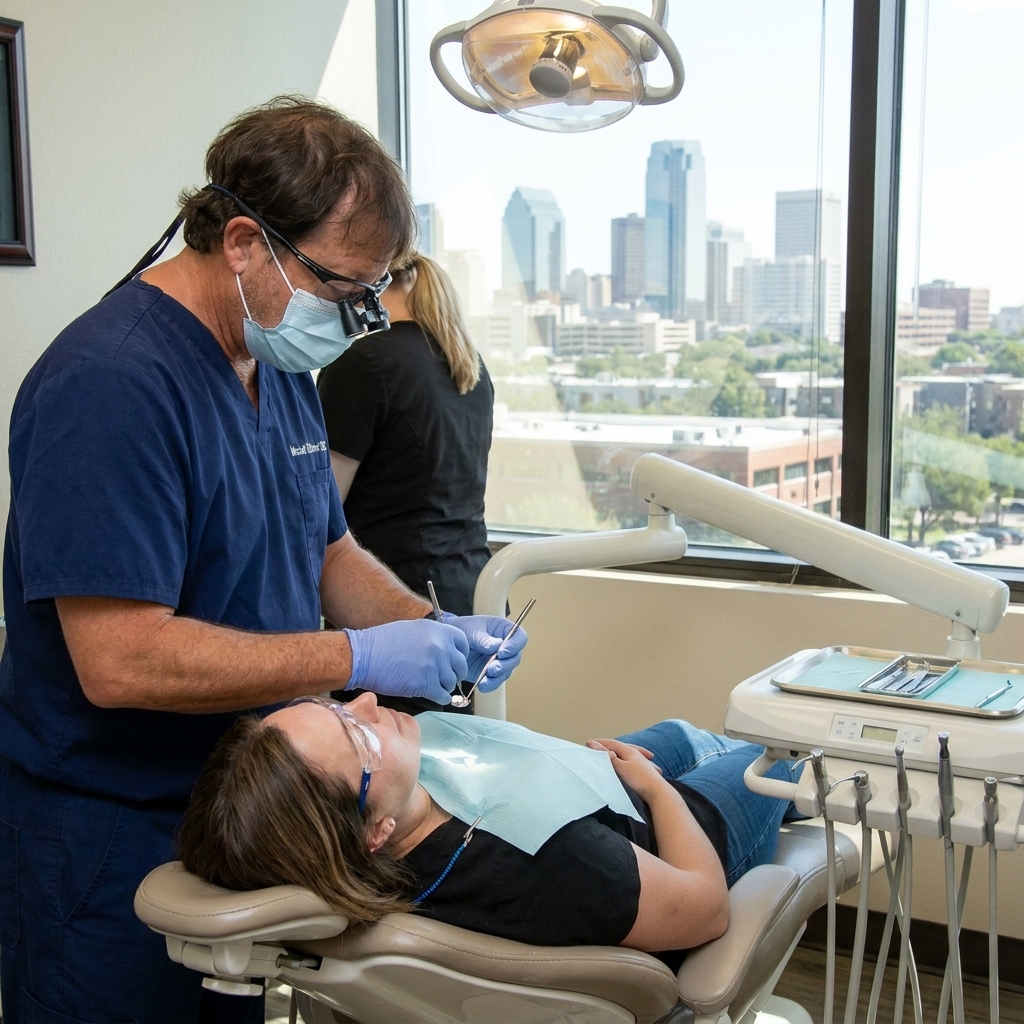


"I was terrified about getting my wisdom teeth out — I'd heard horror stories for years. Dr. Brown was so calm and thorough in explaining exactly what would happen. I felt the pressure but absolutely no pain. I was home within an hour and felt much better within two days. The aftercare instructions were incredibly detailed and easy to follow. Highly recommend."
Fort Worth, TX — Gentle Tooth Removal
Tooth Extractions —
Gentle, Comfortable & Safe
When a tooth cannot be saved, Dr. Marshall H. Brown performs gentle, comfortable extractions that prioritise your wellbeing at every step. Alternatives are always explored first — and when removal is necessary, we ensure the process is as smooth and pain-free as possible, with clear aftercare guidance so you heal quickly and comfortably.
- Local Anaesthesia
- Simple & Surgical Extractions
- Wisdom Tooth Removal
- Replacement Options Discussed
- Types of Extractions
- 3 Types
- Simple Extraction Time
- 20–40 min
- Google Rating
- 4.7★
- Most Insurance Accepted
- Yes
When Extraction Becomes Necessary
Why a Tooth May Need
to Be Removed
You and Dr. Brown may determine that a tooth extraction is necessary for any number of reasons. Dr. Brown's priority is always to save your natural tooth wherever possible — alternatives to extraction are always explored and discussed before proceeding with removal.
The removal of a single tooth can lead to problems related to your chewing ability, jaw joint health, and shifting of surrounding teeth — all of which can have a major impact on your long-term dental health. This is why Dr. Brown will always discuss replacement options at the same appointment, so you have a clear plan from day one.
Severe Decay
When decay has progressed beyond what a filling or crown can repair, extraction may be the only option to prevent infection spreading.
Advanced Gum Disease
Severe periodontal disease can destroy the bone supporting a tooth to the point where the tooth can no longer be held in the jaw.
Fracture Beyond Repair
Teeth broken in an accident or fractured below the gum line may be impossible to restore with a crown or other restoration.
Impacted Teeth
Teeth that are stuck in the jawbone and cannot erupt normally — most commonly wisdom teeth — often need removal before they cause crowding or infection.
Orthodontic Preparation
In preparation for braces or aligner treatment, one or more teeth may need to be removed to create sufficient space for the remaining teeth to move.
Overcrowding
Severely overcrowded teeth that cannot be adequately aligned even with orthodontics may require the removal of one or more teeth to restore proper bite.
Why Replacing the Tooth Matters
Leaving a gap after extraction causes surrounding teeth to shift, can lead to bone loss, and affects your bite and facial structure. Dr. Brown will always discuss tooth replacement options at the same appointment.
Which Type Do You Need?
Three Types of Tooth Extraction
at Our Fort Worth Practice
Dr. Brown performs all types of tooth extraction. The appropriate procedure depends on the position, condition, and accessibility of the tooth being removed.

Simple Extraction
A simple extraction is performed on a tooth that is visible in the mouth and can be accessed without surgery. After local anaesthesia is administered, Dr. Brown uses a dental elevator to loosen the tooth in its socket, then removes it with forceps. The procedure is straightforward and typically completed in 20–40 minutes.
- Fully visible, accessible tooth
- No incision required
- Local anaesthesia — no pain
- Completed in 20–40 minutes

Surgical Extraction
A surgical extraction is required when a tooth has broken off at the gum line, is not fully erupted, or cannot be accessed without making a small incision in the gum tissue. Some teeth also require sectioning — a very common procedure where the tooth is cut into sections and removed one piece at a time when the root is curved or the socket cannot expand enough for removal.
- For broken or partially erupted teeth
- Small incision in gum tissue
- Tooth sectioning when roots are curved
- Local anaesthesia — comfortable throughout
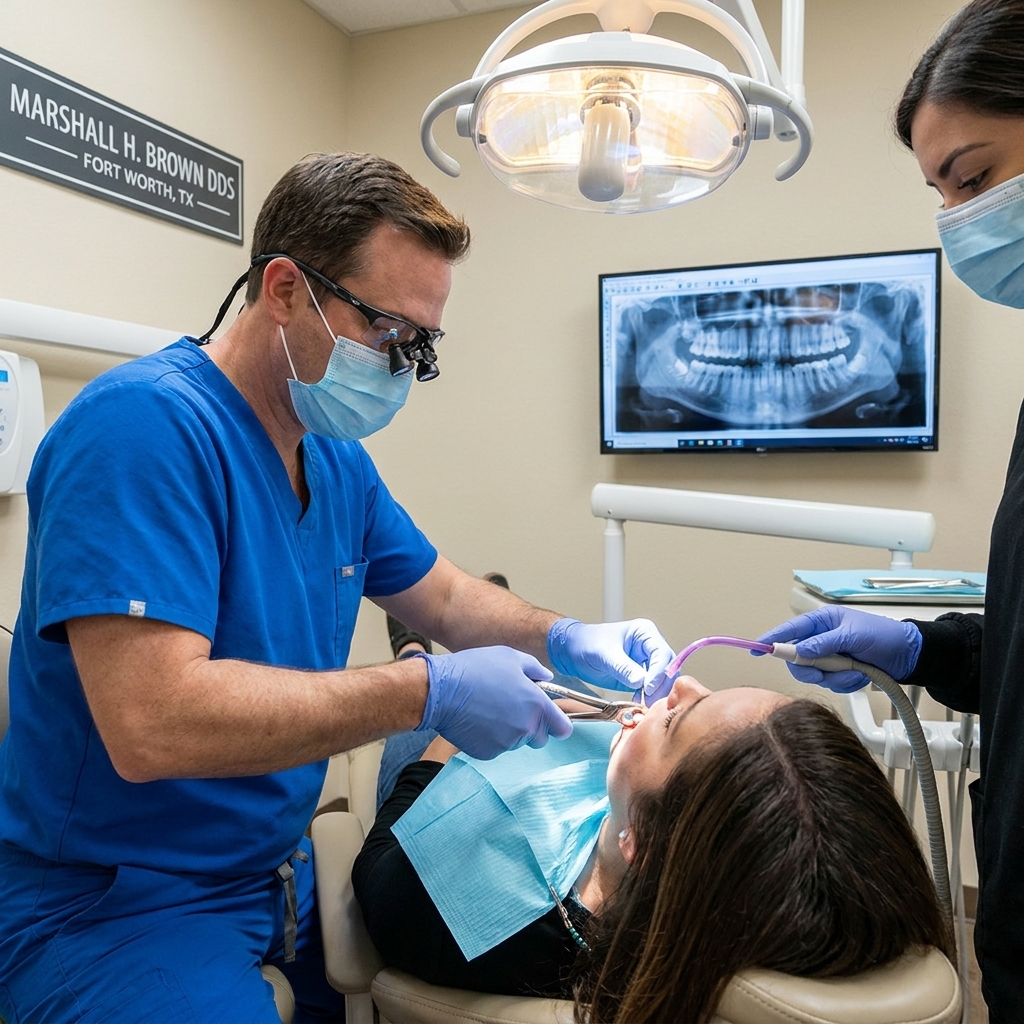
Wisdom Tooth Removal
Wisdom teeth (third molars) are the last teeth to emerge and frequently become impacted — stuck in the jawbone, partially erupted, or growing at an angle that pushes against adjacent teeth. Impacted wisdom teeth can cause pain, infection, crowding, and damage to neighbouring teeth. Dr. Brown assesses each case individually and recommends removal when needed.
- Impacted and partially erupted teeth
- Prevents crowding and damage to neighbours
- Eliminates wisdom tooth infections
- X-rays taken before every wisdom extraction
What to Expect
The Extraction Process —
Step by Step
Understanding exactly what happens during an extraction helps many patients feel far more relaxed. Here is a clear, honest account of what you will experience from the moment you sit in the chair.
Anaesthesia
Numbing the Area
Dr. Brown will numb your tooth, jawbone, and surrounding gums with a local anaesthetic. The area will be completely numb before any extraction work begins. If you feel anxious, nitrous oxide is available to help you relax.
Pressure — Not Pain
Loosening the Tooth
During the extraction you will feel a lot of pressure. This is completely normal — it comes from firmly rocking the tooth to widen its socket for removal. The anaesthetic has numbed the pain nerves, but the nerves that transmit pressure are not profoundly affected. You feel pressure — not pain.
Sectioning (if needed)
Tooth Sectioning
Some teeth require sectioning — a very common procedure done when a tooth is so firmly anchored in its socket, or the root is curved, that the socket cannot expand enough to remove the tooth whole. Dr. Brown simply cuts the tooth into sections, then removes each section one at a time. This is routine and completely comfortable under local anaesthesia.
Completion
Socket Cleaned & Gauze Placed
Once the tooth is removed, the socket is cleaned and a gauze pad is placed for you to bite down on to control bleeding and begin the clot formation process. Dr. Brown provides full aftercare instructions before you leave.
If you feel pain at any time during the extraction,
please let Dr. Brown know immediately.
Additional anaesthetic can always be administered to ensure
you remain completely comfortable throughout the procedure.
Your Comfort is Always First
Post-Extraction Care — Important
After Your Tooth Extraction —
What You Need to Know
Following these aftercare instructions carefully helps the blood clot form properly, prevents complications like dry socket, and ensures the fastest, most comfortable recovery possible.
Immediately After Extraction — First 30–45 Minutes
Bite firmly on the gauze pad placed by Dr. Brown for 30–45 minutes immediately after the appointment to allow the blood clot to form. If bleeding or oozing continues, place a fresh gauze pad and bite firmly for another 30 minutes. You may need to repeat this several times to stop the flow of blood — this is completely normal.
Critical Do's & Don'ts for the First 72 Hours
✓ Apply Ice for Swelling
Apply an ice pack or unopened bag of frozen peas to the area to keep swelling to a minimum. Swelling usually subsides after 48 hours.
✗ No Straws for 72 Hours
The sucking motion can dislodge or dissolve the blood clot, causing dry socket — a painful complication that significantly delays healing.
✓ Eat Soft, Nutritious Foods
Drink plenty of fluids and eat soft, nutritious food on the day of extraction — yogurt, soup, mashed potatoes. Eat normally as soon as you are comfortable.
✗ No Smoking for 72 Hours
Smoking dramatically increases the risk of dry socket by disrupting blood clot formation and reducing oxygen supply to healing tissue.
✓ Take Pain Medication as Directed
Use pain medication as directed. If antibiotics are prescribed, complete the full course even if symptoms resolve before you finish them.
✗ No Alcohol for 72 Hours
Alcohol can dissolve the blood clot, interact with medications, and slow the healing process. Avoid all alcohol for at least 72 hours.
✓ Resume Oral Hygiene After 24 Hours
Resume your normal dental routine after 24 hours — brushing and flossing at least once a day. This speeds healing and keeps your mouth clean.
✗ No Vigorous Rinsing for 72 Hours
Vigorous swishing can dislodge the blood clot. After 24 hours, gently rinse with warm salt water to keep the site clean.
✓ Rest and Limit Exercise
Limit vigorous exercise for the next 24 hours. Increased blood pressure from physical activity can cause more bleeding from the extraction site.
✗ Don't Brush the Extraction Site
Avoid brushing teeth directly next to the extraction site for the first 72 hours to prevent disturbing the blood clot and healing tissue.
Your Day-by-Day Recovery Timeline
Day 1
Bite on gauze 30–45 min. Rest at home. Apply ice. Eat soft foods. Take pain medication as directed. Avoid straws, smoking, alcohol, vigorous rinsing, and exercise. Do not disturb the clot.
Day 2
Swelling may peak around 24–48 hours — this is completely normal. Continue icing. Begin gentle warm salt water rinses. Resume normal oral hygiene away from the extraction site.
Day 3
Swelling begins to subside. The 72-hour restrictions on straws, smoking, alcohol, and vigorous rinsing end. Most patients feel significantly more comfortable by the end of day three.
Days 4–7
Most patients feel fine and can resume normal activities. The socket continues healing from the inside out. Continue gentle salt water rinses and normal oral hygiene routines.
1–2 Wks
Gum tissue closes over the socket. If not already scheduled, book your tooth replacement consultation with Dr. Brown to prevent bone loss and shifting of adjacent teeth.
Know the Warning Signs
Dry Socket & When
to Call Our Office
What Is Dry Socket?
After tooth extraction, it is important for a blood clot to form in the socket to stop the bleeding and begin the healing process. Dry socket occurs when this clot is dislodged or dissolves before the wound has healed, exposing the underlying bone and nerves to air, food, and fluids.
Dry socket causes severe throbbing pain — typically beginning 2–3 days after extraction — and requires prompt treatment at our office. It is entirely preventable by following the aftercare instructions provided by Dr. Brown.
Call Us Immediately If You Experience:
Heavy or uncontrolled bleeding that doesn't stop with gauze pressure
Severe pain — especially starting 2–3 days after extraction (possible dry socket)
Continued swelling that worsens or persists beyond 2–3 days after extraction
Fever, chills, or signs of spreading infection such as increased redness or discharge
Adverse reaction to prescribed medication or pain relief not working as expected
Numbness or tingling that has not resolved hours after the anaesthetic should have worn off
We're Available at All Times
It is rare for endodontic or extraction patients to experience complications — but if a problem does occur after your extraction, we are available to respond promptly. Do not hesitate to call.
(817) 920-0882Patient Stories
What Our Extraction Patients Say
Tooth extractions are always the last resort at our Fort Worth practice — and when they're needed, we make the experience as comfortable as possible.
"I had a badly broken molar that had been causing me grief for months. Dr. Brown explained that it couldn't be saved and needed to come out. He also explained the implant option so I wasn't left with a gap. The extraction itself was quick and painless. He discussed everything before he started and I never felt anxious. Incredible professional — I wouldn't go anywhere else."
"I came in with a severely decayed tooth and a lot of fear. Dr. Brown first tried to see if anything could be done to save it — when it was clear it had to come out, he walked me through every step. I felt pressure during the extraction but zero pain. The written aftercare sheet was so helpful. Healed perfectly within a week. Five stars without question."
Your Questions, Answered
Tooth Extraction FAQs
Still have questions? Call us at (817) 920-0882 — we're always happy to help.
No. The extraction procedure is performed under local anaesthesia, which numbs the tooth, jawbone, and surrounding gums completely. During the extraction you will feel pressure — this is from rocking the tooth to widen its socket — but you should not feel pain. If you feel any pain at any point, please tell Dr. Brown immediately so additional anaesthetic can be administered.
A simple extraction typically takes 20 to 40 minutes including anaesthesia time. Surgical extractions, impacted teeth, or wisdom teeth with curved roots may take longer depending on the complexity of the case. Dr. Brown will give you a realistic time estimate at your consultation appointment.
Dry socket occurs when the blood clot that forms in the extraction socket is dislodged or dissolves before healing is complete, exposing the underlying bone and causing severe pain typically beginning 2–3 days after extraction.
To prevent dry socket: do not use straws, smoke, drink alcohol, or rinse vigorously for 72 hours after extraction. Do not brush teeth directly next to the extraction site for 72 hours. Avoid vigorous exercise for 24 hours. Call our office immediately if you experience severe pain 2–3 days after extraction.
Drink plenty of fluids and eat soft, nutritious foods on the day of extraction — good options include yogurt, soup, scrambled eggs, mashed potatoes, smoothies (no straws), and applesauce. Avoid hard, crunchy, chewy, or spicy foods until the socket has healed. You can eat normally as soon as you are comfortable.
In most cases, yes. The removal of a single tooth can lead to problems with chewing ability, jaw joint health, and shifting of surrounding teeth — all of which can have a major long-term impact on your dental health.
Dr. Brown will always discuss tooth replacement options at the time of extraction. Options include:
- Dental implants — the gold standard, preserves bone
- Dental bridges — fixed solution anchored to adjacent teeth
- Partial dentures — removable option for multiple teeth
Call our office at (817) 920-0882 immediately if you experience any of the following:
- Heavy or uncontrolled bleeding that doesn't stop with gauze
- Severe pain — especially beginning 2–3 days after extraction
- Continued swelling lasting more than 2–3 days
- Fever or signs of spreading infection
- An adverse reaction to prescribed medication
We are available at all times to respond to post-extraction complications. Do not hesitate to call — early intervention always leads to the best outcomes.
Tooth Pain or Broken
Tooth? Call Us Today.
Dr. Brown always explores alternatives to extraction first. When removal is necessary, we make the process as comfortable and straightforward as possible — with full aftercare support.
Book a Consultation (817) 920-0882
4.7★ Rating — 269+ Google Reviews
Most Insurance Accepted
New Patients Welcome
Alternatives Always Explored First
Dr. Brown will discuss all alternatives to extraction before recommending removal — saving your natural tooth is always the preferred outcome.
Related Services
Treatments That Work
Alongside or Instead of Extraction
Root Canal Treatment
Alternative to extraction for infected teeth
Dental Implants
Best permanent replacement after extraction
Dental Bridges
Fixed tooth replacement after extraction
Dentures
For multiple tooth extraction replacement
Dental Crowns
May save a broken tooth from extraction
All General Treatments
View our full treatment menu